|
The Week Ahead: Highlights
Asia-Pacific Preview
Watching for Another RBA Rate Hike
By Brian Jackson, Econoday Economist
The Reserve Bank of Australia policy meeting will be the
main focus. Officials have raised policy rates at each of their two previous
meetings and indicated that further policy tightening will be considered if the
inflation outlook does not improve. Since then, the spike in fuel prices caused
by the Iran conflict has pushed monthly inflation sharply higher, suggesting
another rate hike is likely next week. Australia will also report household
spending and trade data in the week ahead.
PMI surveys for April will also be a major focus in the
Asia-Pacific region. PMI surveys for China published this week showed mixed
results, but next week's reports should provide further information about the
impact of the Iran conflict on activity, sentiment and cost pressures in the
region.
Taiwan will report trade and inflation data next week, while
Hong Kong will publish its GDP report and New Zealand will publish quarterly
labour market data.
Europe Preview
After an Eventful Week, Eyes Turn to German Data
By Marco Babic, Econoday Economist
As the conflict in the Middle East enters its third month
with no signs of abating, last week's inflation data showed to what extent it's
impacting prices. Consumer inflation picked up to levels that are bound to make
the European Central Bank uncomfortable. While the ECB kept rates steady, as
did the US Federal Reserve, policy makers are facing a dilemma of combating
inflation and keeping tepid economic growth from turning negative.
Certainly core inflation rates which strip out the effects
of higher energy costs reflect more moderate inflation. In fact, falling energy
prices prior to the conflict have kept inflation muted. Still, higher energy
prices force consumers into choices on discretionary spending which will crimp
GDP. It's small comfort to consumers to hear that inflation excluding energy
and fuel is moderate. After all, inflation excluding everything is flat.
Germany will provide some clues as to how industry is coping
with the conflict. On Thursday, March factory orders are scheduled for release,
followed by industrial production on Friday. There has been some evidence that
production has picked up in other economies as businesses attempt to boost
inventory and, by extension, production to get ahead of expected price
increases for raw materials, particularly intermediate goods. At the same time,
they are ramping up production to keep up with orders. While increased
industrial activity is welcome, it would be increasing for reasons that are not
optimal.
In addition, trade data for France and Germany are released
Thursday and Friday, respectively for March. This could give indications of how
much has been affected by the conflict. The effect of tariffs which was such a
big talking point for months, now seems to have turned to a whisper.
Ultimately, the European Central Bank will likely be forced
to raise interest rates just at a time when economic growth is sluggish.
US Preview
US Employment Report in Focus
By Theresa Sheehan, Econoday Economist
The highlight in the May 4 week will be the April employment
report at 8:30 ET on Friday. The April numbers on payrolls and the unemployment
rate could set the tone for the labor market in the second quarter of 2026.
With the conflict in Iran stretching on with no progress in concluding the
violence, businesses face ongoing geopolitical uncertainties. Businesses will
be reluctant to expand payrolls or hire into open positions. Moreover, the
upward price pressures from energy costs may lead to some layoff activity that
could accelerate if a resolution in hostilities is not reached soon.
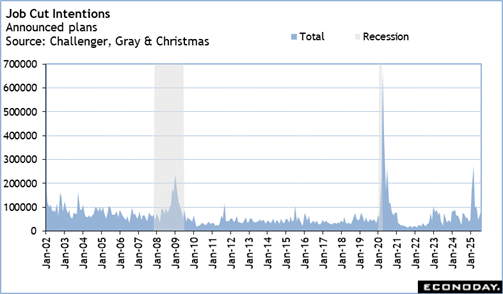
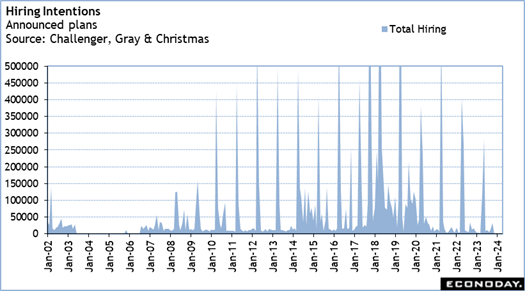
The Challenger report for job cut and hiring intentions in
April at 7:30 ET on Thursday should reflect which industries are feeling the
pinch of increased costs and worries about a return of inflationary pressures
and concerned about no relief for higher energy prices in the near term. There
may be outright layoffs and/or elimination of planned hiring. The only sector
that probably isn't affected as yet is healthcare which has been the major
source of new jobs in recent months. Hiring plans are likely top be limited to
a few sectors that normally add to payrolls in the spring largely retail and
leisure and hospitality but this could be less than usual.
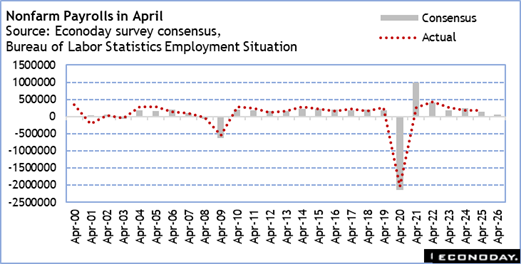
While early estimates for nonfarm payrolls in April are for
tepid job gains, the April report has a strong tendency to come in below the
consensus forecast and then subsequently be revised lower in the following
month's report. April can be a tough month to forecast due to the timing of the
spring holidays, and if businesses decided to speed up hiring in March to get
ahead of the demand for seasonal workers. The survey reference week for April
is 5 weeks in 2026, so it should capture a full picture of payroll gains in the
early part of the month.
Stagnant payroll growth or even some modest declines
will affect the FOMC's outlook for monetary policy. The committee will have to
determine of a soft labor market is more of a risk to growth than rising
inflation even if the pass through from energy costs is of limited duration.
There is an interesting notice on the BLS website the
indicates that there may be an effort to backfill some of the missing data in
the consumer price index, or at least prepare for some of the consequences like
creating seasonal adjustment factors (https://www.bls.gov/bls/bls-engages-expert-panels-regarding-missing-consumer-expenditure-data.htm).
The BLS is holding public meetings with the National Association for Business
Economics (NAB) and Committee on National Statistics (CNSTAT) on May 7 and 8,
respectively.
The Week Ahead: Econoday Consensus Forecasts
Monday
US Motor Vehicle Sales for April (Any Time)
Consensus Forecast, Total Vehicle Sales - Annual Rate: 16.1
M
Consensus Range, Total Vehicle Sales - Annual Rate: 16.0
M to 16.2 M
The consensus looks for sales lower at a 16.1 million unit
rate in April from 16.3 million in March.
India PMI Manufacturing Final for April (Mon 1030
IST; Mon 0500 GMT; Mon 0100 EDT)
Consensus Forecast, Index: 55.9
Consensus Range, Index: 55.9 to 55.9
Forecasters see no revision from the flash at 55.9 for the
April final, up from 53.9 in the March final.
France PMI Manufacturing Final for April (Mon 0850
CEST; Mon 0650 GMT; Mon 0250 EDT)
Consensus Forecast, Index: 52.8
Consensus Range, Index: 52.8 to 52.8
The consensus looks for no revision from the flash at 52.8
for the April final, up from 50.0 in March
Germany PMI Manufacturing Final for April (Mon 0955
CEST; Mon 0755 GMT; Mon 0355 EDT)
Consensus Forecast, Index: 51.2
Consensus Range, Index: 51.2 to 51.2
The consensus looks for no revision from the flash at 51.2
for the April final, down from 52.2 in March.
Eurozone PMI Manufacturing Final for April (Mon 1000
CEST; Mon 0800 GMT; Mon 0400 EDT)
Consensus Forecast, Index: 52.2
Consensus Range, Index: 51.2 to 52.2
The consensus looks for no revision from the flash at 52.2
for the April final, up from 51.6 in March.
US Factory Orders for March (Mon 1000 EDT; Mon 1400
GMT)
Consensus Forecast, M/M: 0.5%
Consensus Range, M/M: -0.1% to 1.0%
With durable goods orders already reported up 0.8 percent
for March, the consensus sees factory orders up a similar 0.5 percent.
Tuesday
Australia Household Spending for March (Tue 1130
AEST; Tue 0130 GMT; Mon 2130 EDT)
Consensus Forecast, M/M: 2.0%
Consensus Range, M/M: -0.5% to 2.4%
The consensus sees spending up 2.0 percent in March in
nominal terms after rising 0.3 percent in February. This gets a big boost from
the effect of higher fuel prices starting in March.
Australia RBA Announcement (Tue 1430 AEST; Tue 0430
GMT; Tue 1230 EDT)
Consensus Forecast, Change: 25 bp
Consensus Range, Change: 0 bp to 25 bp
Consensus Forecast, Level: 4.35%
Consensus Range, Level: 4.10% to 4.35%
After two straight 25 basis point increases, the RBA is
expected to raise rates by another 25 bp at this meeting as inflation remains
too hot.
Canada Merchandise Trade for March (Tue 0830 EDT; Tue
1230 GMT)
Consensus Forecast, Balance: -C$3.4 B
Consensus Range, Balance: -C$3.8 B to -C$2.0 B
The consensus sees a deficit of C$3.4billion in March after
a C$5.743 billion deficit in February.
US International Trade in Goods and Services for March (Tue
0830 EDT; Tue 1230 GMT)
Consensus Forecast, Balance: -$60.4 B
Consensus Range, Balance: -$65.2 B to -$57.6 B
Forecasters see the deficit widening to $60.4 billion in
March from $57.3 billion in February.
US PMI Composite Final for March (Tue 0945 EDT; Tue 1345
GMT)
Consensus Forecast, Composite Index: 52.0
Consensus Range, Composite Index: 52.0 to 52.0
Consensus Forecast, Services Index: 52.1
The consensus looks for no revision from the flash at 52.0
for the April composite final, up from 50.3 in March. For services, an upward revision
is expected to 52.1 from 51.3 in the flash versus 49.8 in March.
US New Home Sales for February (Tue 1000 EDT; Tue 1400
GMT)
Consensus Forecast, Annual Rate: 610 K
Consensus Range, Annual Rate: 599 K to 675K
US New Home Sales for March (Tue 1000 EDT; Tue 1400
GMT)
Consensus Forecast, Annual Rate: 668K
Consensus Range, Annual Rate: 618K to 700K
Home sales seen recovering to a 668,000 rate in March, and
to 610,000 in February from a surprisingly low 587,000 in January.
US ISM Services Index for April (Tue 1000 EDT; Tue 1400
GMT)
Consensus Forecast, Index: 53.9
Consensus Range, Index: 53.2 to 55.0
Similar to the ISM manufacturing report that was unchanged
from March to April at 52.7, the services index is seen flat at 53.9 in April
versus 54.0 in March.
Wednesday
New Zealand Labour Market Conditions for First Quarter (Wed
1045 NZST; Tue 2245 GMT; Tue 1845 EDT)
Consensus Forecast, Unemployment Rate: 5.4%
Consensus Range, Unemployment Rate: 5.3% to 5.4%
The jpbless rate is expected flat at 5.4% in Q1 versus 5.4
percent in Q4.
South Korea CPI for April (Thu 0800 KST; Wed 2300
GMT; Wed 1900 EDT)
Consensus Forecast, Y/Y: 2.5%
Consensus Range, Y/Y: 2.4% to 2.7%
CPI expected up 2.5 percent on year in April versus 2.2
percent in March.
China PMI Composite for April (Wed 0945 CST; Wed 0145
GMT; Tue 2145 EDT)
Consensus Forecast, Services Index: 52.0
Consensus Range, Services Index: 52.0 to 52.5
Services expected nearly unchanged at 52.0 in April versus
52.1 in March.
France Industrial Production for March (Wed 0845 CEST;
Wed 0645 GMT; Wed 0245 EDT)
Consensus Forecast, M/M: 0.2%
Consensus Range, M/M: 0.2% to 0.5%
Output seen up 0.2 percent in March on the month versus
minus 0.7 percent in February.
France PMI Composite Final for April (Wed 0850 CEST;
Wed 0650 GMT; Wed 0250 EDT)
Consensus Forecast, Services Index: 46.5
Consensus Range, Services Index: 46.5 to 46.8
The consensus looks for no revision from 46.5 in the flash
for services.
Eurozone PMI Composite Final for April (Wed 0900 CEST;
Wed 0700 GMT; Wed 0300 EDT)
Consensus Forecast, Composite Index: 48.6
Consensus Range, Composite Index: 48.6 to 48.6
Consensus Forecast, Services Index: 47.4
Consensus Range, Services Index: 47.4 to 47.4
The consensus looks for no revision from the flash at 48.6
for the April composite final versus 50.7 in March. For services, no revision
expected from 47.4 in the flash versus 50.2 in March.
Germany PMI Composite Final for April (Wed 0955 CEST;
Wed 0755 GMT; Wed 0355 EDT)
Consensus Forecast, Composite Index: 48.3
Consensus Range, Composite Index: 48.3 to 48.3
Consensus Forecast, Services Index: 46.9
Consensus Range, Services Index: 46.9 to 46.9
The consensus looks for no revision from the flash at 48.3
for the April composite final versus 51.9 in March. For services, no revision
expected from 46.9 in the flash versus 50.9 in March.
UK PMI Composite Final for April (Wed 0930 BST; Wed 1030
GMT; Wed 0430 EDT)
Consensus Forecast, Composite Index: 52.0
Consensus Range, Composite Index: 52.0 to 52.0
Consensus Forecast, Services Index: 52.0
Consensus Range, Services Index: 52.0 to 52.0
The consensus looks for no revision from the flash at 52.0
for the April composite final versus 50.3 in March. For services, no revision
expected from 52.0 in the flash versus 50.5 in March.
US ADP Employment Report for April (Wed 0815 EDT; Wed
1215 GMT)
Consensus Forecast, Private Payrolls - M/M: 85K
Consensus Range, Private Payrolls - M/M: 40K to 140K
Payrolls seen up a decent 85K after rising 62K in March.
Thursday
Australia International Trade in Goods for March (Thu
1130 AEST; Thu 0130 GMT; Wed 2130 EDT)
Consensus Forecast, Balance: A$4.25 B
Consensus Range, Balance: A$2.0 B to A$7.5 B
The surplus expected down to A$4.25 billion in March from
A$5.586 billion in February.
Germany Manufacturing Orders for March (Thu 0800 CEST;
Thu 0600 GMT; Thu 0200 EDT)
Consensus Forecast, M/M: 1.0%
Consensus Range, M/M: -1.5% to 1.7%
Manufacturing orders are expected up another 1.0 percent on
the month in March after rising 0.9 percent in February.
Eurozone Retail Sales for March (Thu 1100 CEST; Thu 0900
GMT; Thu 0500 EDT)
Consensus Forecast, M/M: -0.1%
Consensus Range, M/M: -1.0% to 0.4%
Consensus Forecast, Y/Y: 1.3%
Consensus Range, Y/Y: 0.2% to 1.4%
Sales expected down 0.1 percent in March on the month and up
1.3 percent on year.
US Jobless Claims for Week 05/02 (Thu 0830 EDT; Thu
1230 GMT)
Consensus Forecast, Initial Claims - Level: 205K
Consensus Range, Initial Claims - Level: 190K to 215K
Claims expected to rebound to 205K in the latest week after
a surprise 26K drop to 189k a week ago.
US Productivity and Costs for First Quarter (Thu 0830
EDT; Thu 1230 GMT)
Consensus Forecast, Nonfarm Productivity - Annual Rate:
1.7%
Consensus Range, Nonfarm Productivity - Annual Rate: 1.4%
to 2.0%
Consensus Forecast, Unit Labor Costs - Annual Rate: 2.0%
Consensus Range, Unit Labor Costs - Annual Rate: 1.6%
to 3.6%
The consensus looks for productivity up 1.7 percent in Q1
and unit labor costs up 2.0 percent. In Q4 the numbers were 1.8 percent and 4.4
percent, respectively.
US Construction Spending for February (Thu 1000 EDT;
Thu 1400 GMT)
Consensus Forecast, M/M: 0.2%
Consensus Range, M/M: 0.1% to 0.3%
US Construction Spending for March (Thu 1000 EDT; Thu
1400 GMT)
Consensus Forecast, M/M: 0.4%
Consensus Range, M/M: -0.1% to 0.6%
Construction expected to rebound by 0.2 percent in February
and another 0.4 percent on the month in March after dipping by 0.3 percent in
January.
US Consumer Credit for March (Thu 1500 EDT; Thu 1900
GMT)
Consensus Forecast, M/M: $12.0 B
Consensus Range, M/M: $10 B to $12.9 B
Expected up by a moderate $12 billion in March after
increasing by $9.5 billion in February.
Friday
Germany Industrial Production for March (Fri 0800 CEST;
Fri 0600 GMT; Fri 0200 EDT)
Consensus Forecast, M/M: -0.2%
Consensus Range, M/M: -1.5% to 3.0%
Consensus Forecast, Y/Y: -2.5%
Consensus Range, Y/Y: -3.7% to -1.7%
Sales seen down 0.2 percent on month in March and down a
dismal 2.5 percent on year.
Germany Merchandise Trade for March (Fri 0800 CET;
Fri 0600 GMT; Fri 0200 EDT)
Consensus Forecast, Balance: E16.5 B
Consensus Range, Balance: E14.0 B to E20.1 B
The consensus sees the surplus down at E16.5 billion versus
E19.8 billion in February.
Canada Labour Force Survey for April (Fri 0830 EDT;
Fri 1230 GMT)
Consensus Forecast, Employment - M/M: 16K
Consensus Range, Employment - M/M: 6K to 25K
Consensus Forecast, Unemployment Rate: 6.7%
Consensus Range, Unemployment Rate: 6.6% to 6.7%
Employment bouncing back a bit in March and April from
losses early in January and February but not enough to move the jobless rate
from 6.7 percent in April.
US Employment Situation for April (Fri 0830 EDT; Fri
1230 GMT)
Consensus Forecast, Nonfarm Payrolls - M/M: 63K
Consensus Range, Nonfarm Payrolls - M/M: 0 to 150K
Consensus Forecast, Unemployment Rate: 4.3%
Consensus Range, Unemployment Rate: 4.2% to 4.4%
Consensus Forecast, Private Payrolls - M/M: 67K
Consensus Range, Private Payrolls - M/M: 40K to 95K
Consensus Forecast, Average Hourly Earnings - M/M: 0.3%
Consensus Range, Average Hourly Earnings - M/M: 0.2%
to 0.3%
Consensus Forecast, Average Hourly Earnings - Y/Y: 3.8%
Consensus Range, Average Hourly Earnings - Y/Y: 3.6%
to 3.8%
Consensus Forecast, Average Workweek: 34.2
Consensus Range, Average Workweek: 34.2 to 34.3
A moderate increase of 63K is the call for nonfarm payrolls
with the jobless rate flat at 4.3 percent.
US Consumer Sentiment for May (Fri 1000 EDT; Fri 1400
GMT)
Consensus Forecast, Index: 49.3
Consensus Range, Index: 48.0 to 53.0
Sentiment expected to slip to 48.6 in the first report for
May from an already gloomy 49.8 in the April final as consumers are unhappy
about rising prices for gas and worried about the economic outlook.
|


![[Econoday]](images/econoday_logo_slim.gif)
![[Econoday]](images/logo.gif)